 |
|
|
|
Production UEIP
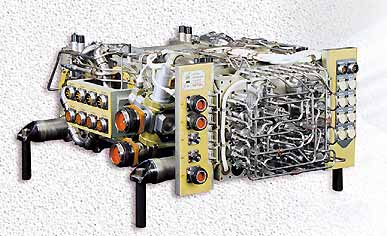
Alkaline Matrix Type Hydrogen-Oxygen Fuel Cell Generator (FCG) "BURAN" Spacecraft Board Power Supply System.
On a photo: Alkaline Matrix Type Hydrogen-Oxygen Fuel Cell Generator (FCG) "BURAN" Spacecraft Board Power Supply System.
Function and design
Fuel cell generator (FCG) is a device for direct conversion of the chemical energy of fuel to the electric energy. The conversion takes place on fuel cell electrodes. Fuel cells (FC) form fuel cell stack (FCS).
The components of the system are:
● hydrogen supply system;
● oxygen supply system;
● inert impurities removal system;
● product water removal system;
● moisture separation and removal system;
● coolant circulation system; automatic diagnostics system (fire and explosion protection);
● Fuel cell generator includes a power section and automatics section, which provides automatic operation.
Advantages
● High energy conversion efficiency.
● Ideal ecological cleanliness: product water is more clean than the spring water. Quiet operation. Absence of pollution.
● Insensitivity to spacestate, resistance to high overloads (linear load - 10g; impact load - up to 100g).
Application:
Main application of FCG are:
● space engineering;
● submarines of different classes;
● electromobiles, hydrogen fuelled airplanes;
● remotely controlled self contained robotic systems working in the most hazardous environment.
a) FCG performance:
| Voltage, V | 34...29 |
| Power, kW | |
| nominal | 10 |
| peak | 25 |
| Service life, hour | 2000 |
| Efficiency, % | |
| at nominal load | 65...70 |
| Reagent consumption, g/A*h | 11,4 |
Weight, kg | |
| power section | 145 |
| automatics section | 15 |
Dimensions, mm | |
| power section | 920x700x360 |
| automatics section | 275x350x372 |
| Operation | fully automatic |
Operation
a) preparation for operation
To start the fuel cell generator it is necessary to supply hydrogen and oxygen to fuel cell inlets, to connect the electric and heat loads (or heat exchange device). Provisions must be made to substitute hydrogen and oxygen with argon (nitrogen) in amount of 50 litres for an operating cycle.
Electrolyte and coolant filling in on operation site is not needed.
b) start-up procedure
Start-up of fuel cell generator is performed automatically with a control processor. Start-up is initiated by "START" command from computer's control unit; then the following operations are performed:
● oxygen and hydrogen supply to generator inlets;
● generator inlet electric valves opening;
● oxygen and hydrogen cavities purging;
● heat exchange system pumps actuation;
● heater connection to the mains bus.
It takes 40-90 minutes to heat-up generator to operating temperature; after that the computer produces "Ready" signal, then generator is able to supply useful power in accordance with its volt-ampere characteristics.
c) maintenance
While in operation supply of hydrogen and oxygen and product water removal (accumulation) should be provided. All parameters are controlled automatically.
d) shut-down procedure
1. Scheduled shut-down
Generator is shut-down automatically after receiving a "STOP" command from computer's control unit; then the following operations are performed:
● electric load disconnection;
● inert gas (argon, nitrogen) supply to generator inlets;
● hydrogen and oxygen cavities purging;
● closing electric valves and switching off pumps of temperature control system.
2. Emergency shut-down
After receiving the emergency signal from fire and explosion protection system generator is automatically shut-down. The following operations are performed:
electric load disconnection;
closing electric valves and switching off pumps of the temperature control system;
appropriate message issuing to computer control unit.
Patent Protection of FCG
Electrochemical generator design as a whole and the parts of it are covered by 19 USSR Inventor's Specifications.
Generator parts manufacturing methods and pre-starting procedures are covered by 27 USSR Inventor's Specification.
The List of "KNOW-HOW"
● Hydrogen electrode manufacturing methods.
● Oxygen electrode manufacturing methods.
● Catalyst manufacturing methods.
● Matrix manufacturing methods.
● Fuel cell stack pre-start procedures.
● Frame cooler manufacturing methods.
● Sealing compound manufacturing methods and composition.
● Porous water transfer materials.
● Hydrogen pump operating mode.
FCG volt-ampere characteristics
| Current, A | Voltage, V | Power, kw | ||
| 0 | 36,8 | 36,7 | 0 | 0 |
| 50 | 32,8 | 32,6 | 1,64 | 1,63 |
| 100 | 32,6 | 32,4 | 3,26 | 3,24 |
| 150 | 32,2 | 31,8 | 4,83 | 4,77 |
| 200 | 31,8 | 31,3 | 6,37 | 6,26 |
| 310 | 31,3 | 30,4 | 9,70 | 9,43 |
| 500 | 30,4 | 29,1 | 15,19 | 14,53 |
| 1000 | 28,1 | 25,4 | 28,09 | 25,44 |
FC working conditions (automatically controlled):
| Temperature, °C | 100 |
| Gas pressure, MPa | 0,4 |
| Electrolyte (KOH) concentration, % | 38...40 |
FC characteristics in a FCG: | |
| Specific weight, g/cm3 | 0,48 |
| Voltage, V | |
| unloaded | 1,150...1,160 |
| under 0,2 A/cm load | 0,970...0,980 |
| under 1 A/cm load | 0,782...0,798 |
| Voltage variation, V at 30% electrolyte volume change under 0,2 A/cm load | 0,010 |
Guarantee
● Service life - 1200 hours (perspective 5000 hr).
● Service shelf life - 10 years (since fabrication date).
● Guarantied service life - 5 years (since fabrication date).
● Reliability.
"PHOTON" development stages
● Research and development finished in 1988;
● Total operating time in the course of development and maintenance - 80000 hours.
● Perspectives
● Mean-time-to-first-failure - 2000 hours.
Modification of "PHOTON" generator is possible with the increase of voltage up to 160 V. Change of nominal power to the level required for the buyer.
(c) 2007-2025 Uranium, energy and industry | Copying of site materials is allowed with an active link to ueip.org
Privacy policy | Contact


